
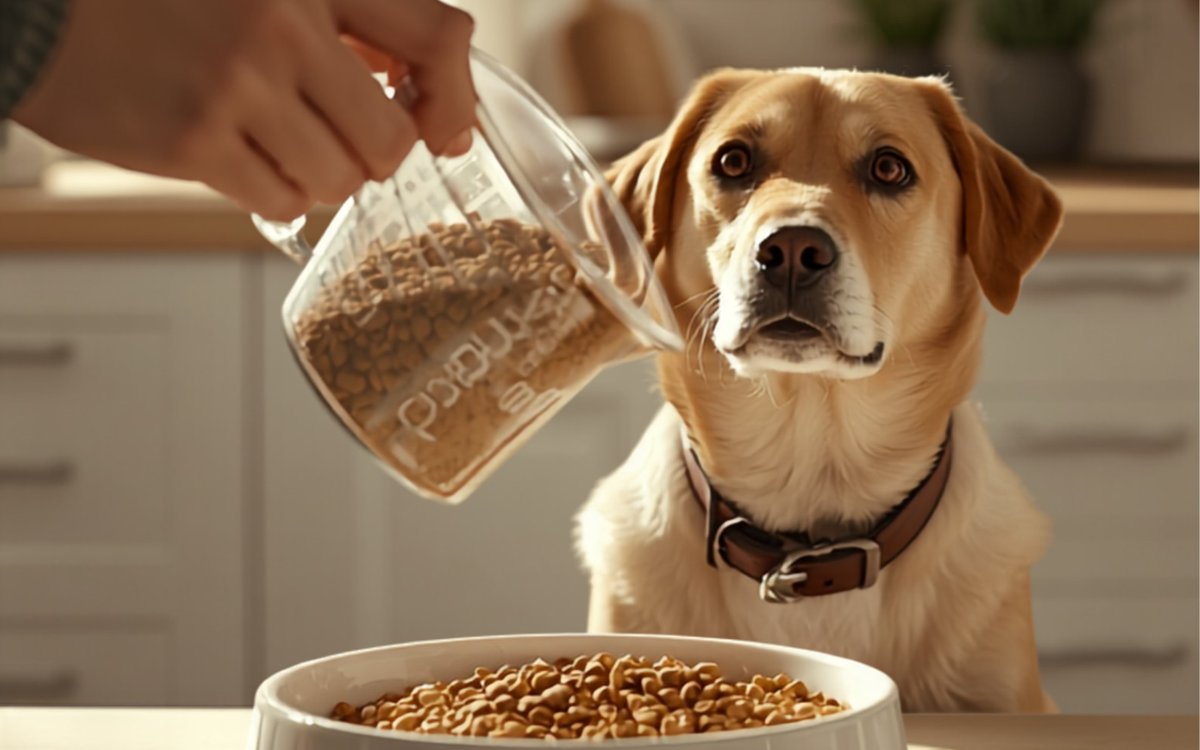
Quick Answer: Most adult dogs need between ½ cup and 3 cups of dry food per day, split across two meals. The right amount depends on your dog’s weight, age, activity level, and the calorie density of the food you’re using. Use the calories-per-cup figure on the bag — not just the generic chart on the back.
One of the most common questions dog owners ask is also one of the most important: am I feeding my dog the right amount? Overfeeding is the leading cause of obesity in dogs, which shortens lifespan and contributes to joint problems, diabetes, and heart disease. Underfeeding causes poor coat condition, low energy, and muscle loss. Getting portions right matters.
The challenge is that the feeding guidelines on dog food bags are often vague, inconsistent, and designed for the “average” dog that may look nothing like yours. This guide walks you through how to calculate the right amount for your specific dog.
How Dog Food Portions Are Actually Calculated
Portion size is based on your dog’s Resting Energy Requirement (RER) — the calories their body needs just to function at rest — adjusted for their lifestyle. Vets use a formula: RER = 70 × (body weight in kg)0.75. From there, a multiplier is applied based on age, activity, and reproductive status.
For practical purposes, the calculation works out to a general range:
- Toy breeds (under 10 lbs): 140–400 calories per day
- Small breeds (10–20 lbs): 400–600 calories per day
- Medium breeds (20–50 lbs): 600–900 calories per day
- Large breeds (50–90 lbs): 900–1,400 calories per day
- Giant breeds (90+ lbs): 1,400–2,100 calories per day
These are starting points, not exact prescriptions. Every dog is an individual.
Adjusting for Age
Puppies need roughly twice the calories of adult dogs relative to body weight because they’re burning energy for growth. They also need meals more frequently — three to four times a day until six months old, then twice daily.
Adult dogs (1–7 years) do well on twice-daily feeding. Splitting the daily portion across two meals reduces bloat risk and keeps blood sugar more stable than once-a-day feeding.
For Senior dogs (7+ years), they typically need 20–30% fewer calories as their metabolism slows and activity decreases. Many vets recommend switching to a senior formula around age 7 for large breeds and age 8–9 for smaller breeds. Watch for weight gain — it creeps up slowly and is easy to miss.
Adjusting for Activity Level
A dog who runs five miles a day needs significantly more food than one who takes a 20-minute walk. Use these multipliers on top of the baseline calorie estimate:
- Inactive / overweight: multiply RER × 1.0 to 1.2
- Average adult, neutered: multiply RER × 1.6
- Intact (not neutered): multiply RER × 1.8
- Active working or sporting dog: multiply RER × 2.0–5.0
- Pregnant or nursing: multiply RER × 2.0–3.5 (ask your vet)
How to Read a Dog Food Label Properly
Here is where most owners go wrong. The guaranteed analysis on the label tells you protein, fat, and fiber percentages — but not calories. The calorie count is listed separately, either as “Metabolizable Energy” or “ME” in kcal/kg or kcal/cup. Find this number and use it.
If a food has 350 kcal/cup and your 30-lb adult dog needs 700 calories per day, she needs exactly 2 cups per day. If you switch to a food with 500 kcal/cup, the same 2 cups would now give her 1,000 calories — 300 more than she needs. Same volume, very different result.
Signs You’re Feeding Too Much or Too Little
Use the rib test as your weekly check: run your fingers along your dog’s ribcage. You should be able to feel individual ribs without pressing hard, but they shouldn’t be clearly visible. If you can’t feel them at all, your dog is likely overweight. If they’re prominent without pressing, your dog may need more food.
Other signs of overfeeding: a sagging belly, no visible waist when viewed from above, sluggishness, labored breathing after light activity.
Signs of underfeeding: visible ribs and hip bones, low energy, poor coat quality, constant hunger or food-seeking behavior.
Use Our Free Dog Feeding Calculator
Rather than running through this math manually every time you change foods, use our free Dog Feeding Calculator. Enter your dog’s weight, age, activity level, and food type, and get a personalized daily calorie target, portion size per meal, and a sample feeding schedule — including guidance for puppies, seniors, and dogs with health conditions.
SJ
Susan J
Online Editor, Doggie General
Susan J has spent more than a decade writing about dog care, behavior, and training. A dog owner since childhood with hands-on experience across Labradors, mixed breeds, and rescue dogs, she draws on guidance from veterinary and behavioral organisations to make expert knowledge practical for everyday owners. Read more about Susan J →
Free AI Tools for This Topic
🍽️ Dog Feeding Calculator 🏥 Dog Symptom Checker
Related Articles
Written and reviewed by the Doggie General editorial team. This article is general information for dog owners, not veterinary advice. If your dog is unwell or you are worried about its health or behavior, contact your veterinarian. When you buy through links on this site we may earn a commission.