Quick Answer: Positive reinforcement training means rewarding the behaviors you want so they happen more often. It is not bribery, it is not permissive, and it does not mean your dog controls you. It is the most scientifically validated approach to dog training, endorsed by every major veterinary and behavioral organization — and it reliably produces better results than punishment-based methods while preserving the dog-owner relationship.
There are two fundamental approaches to dog training: you can change behavior by making things your dog wants more available when it does the right thing (positive reinforcement), or by making things your dog dislikes more available when it does the wrong thing (punishment). Both change behavior. They produce very different dogs.
The Science Behind It
Positive reinforcement is rooted in the work of B.F. Skinner’s operant conditioning and decades of subsequent animal behavior research. The core principle: behavior that produces good outcomes is repeated. Behavior that does not is abandoned.
The evidence base strongly favors positive reinforcement over aversive methods. A 2020 study published in PLOS ONE found that dogs trained with aversive methods showed significantly higher stress indicators (cortisol levels, stress behaviors) during and after training compared to dogs trained with reward-based methods, with no improvement in learning outcomes. Multiple studies find that reward-trained dogs are more confident, faster learners, and more generalized (better at applying learned behaviors in new contexts) than punishment-trained dogs.
Core Concepts
Reward What You Want
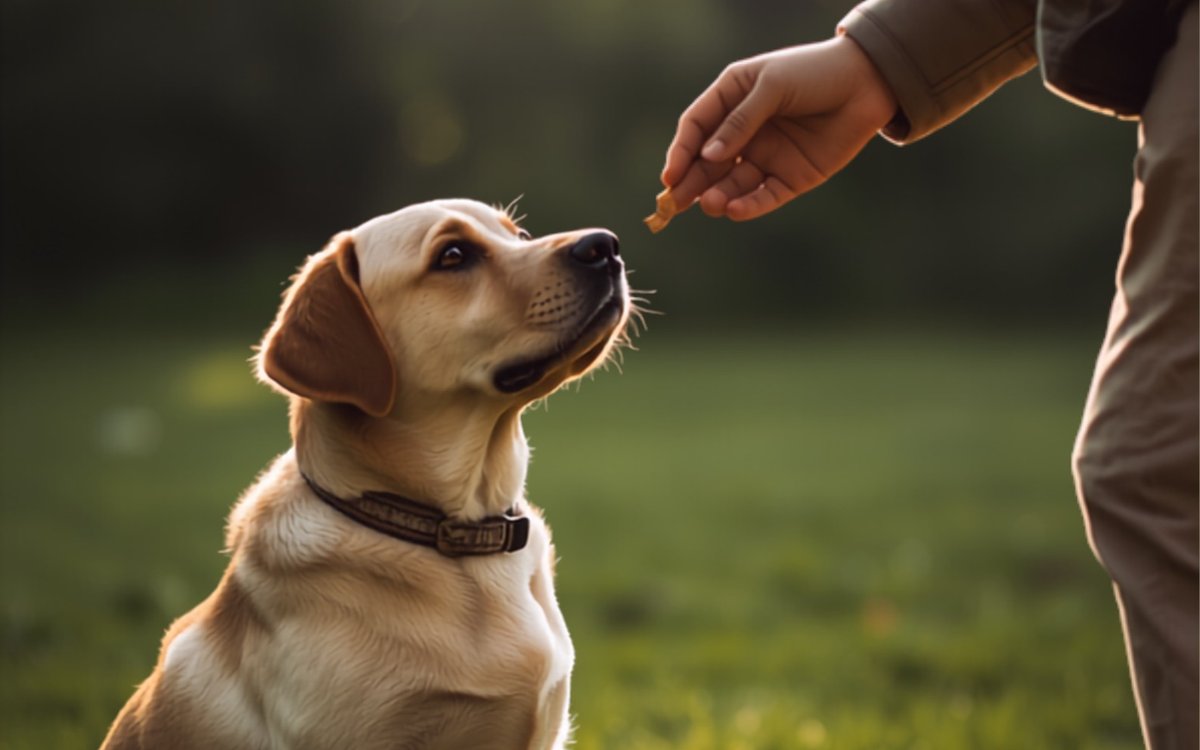
The most powerful technique in positive reinforcement training is also the simplest: catch your dog doing something right and mark it immediately with praise, a treat, or play. Most owners wait for mistakes and respond to those. The most effective trainers spend 80% of their training effort reinforcing correct behavior and 20% managing or redirecting incorrect behavior.
Timing Is Everything
Dogs cannot connect a reward to behavior that happened more than 1–2 seconds ago. If your dog sits and you deliver the treat 5 seconds later while the dog is standing, you have reinforced standing. A marker — a clicker or a consistent word like “yes!” — bridges this gap. The marker sounds the instant the correct behavior happens; the treat follows. Over time, the marker itself becomes a conditioned reinforcer that the dog works for.
Rate of Reinforcement in the Learning Phase
When teaching a new behavior, reinforce it every single time it happens correctly (continuous reinforcement). This builds the behavior quickly. Once the behavior is reliably happening on cue, shift to intermittent reinforcement (reinforcing some correct responses but not all). Intermittently reinforced behaviors are more resistant to extinction — the same principle that makes slot machines compelling.
Management Is Not Failure
Positive reinforcement training uses management — preventing your dog from being able to practice the wrong behavior — as actively as it uses reward. A puppy that cannot access the garbage can cannot practice getting into the garbage. A dog that cannot reach the couch cannot practice jumping on it. Management buys time while training happens, and prevents the dog from self-reinforcing behaviors you don’t want.
Training the Five Foundation Behaviors
Sit: Lure the dog’s nose up and back with a treat until their bottom hits the floor; mark and reward. After 10–15 successful repetitions, introduce the word “sit” just before the lure. Then fade the lure over the next 10–15 repetitions.
Down: From a sit, lure the treat from nose to between the front paws and forward along the ground. As the dog slides into a down, mark and reward. A down is more difficult to lure than a sit — be patient and reward any motion in the right direction initially.
Stay: Ask for a sit or down. Mark and reward for remaining in position, starting with 1–2 seconds and building duration over multiple sessions. Introduce the release word (“free” or “okay”) to tell the dog the stay is over. Then add distance, then distractions. Never increase all three variables simultaneously.
Come (recall): The most important behavior a dog can have, and one of the most commonly undertrained. Every repetition of recall should produce something wonderful — a jackpot of treats, play, or enthusiastic praise. Never call your dog to you for something it dislikes (a bath, nail trim). Go and get the dog instead. An emergency recall — a highly trained recall cue used only in genuine need of immediate response — is trained separately with exceptionally high-value rewards.
Leave it: Put a treat in your closed fist. When the dog stops trying to get it and backs off, mark and reward with a different treat from your other hand. Gradually generalize to items on the floor, then to items at a distance. This behavior has genuine safety applications — it can stop a dog from eating something dangerous.
What Positive Reinforcement Is NOT
It is not bribery. Bribery means showing the treat before the behavior to motivate it. Reinforcement means giving the treat after the correct behavior. Once a behavior is trained, treats are faded from every repetition (though they should never disappear entirely).
It is not permissive. Reinforcing correct behavior does not mean allowing incorrect behavior. Management, redirection, and consistently not reinforcing unwanted behavior are all standard tools in positive reinforcement training.
It does not mean your dog “doesn’t know who’s the boss.” The dominance-hierarchy model of dog behavior was largely debunked by the same researcher (David Mech) whose earlier work popularized it. Dogs are not trying to dominate you; they are trying to navigate their environment. Clear, consistent training that tells the dog exactly what produces good outcomes is far more effective — and more respectful — than trying to establish “pack leadership.”
SJ
Susan J
Online Editor, Doggie General
Susan J has spent more than a decade writing about dog care, behavior, and training. A dog owner since childhood with hands-on experience across Labradors, mixed breeds, and rescue dogs, she draws on guidance from veterinary and behavioral organisations to make expert knowledge practical for everyday owners. Read more about Susan J →
Free AI Tools for This Topic
🐾 Dog Behavior Analysis 🧠 Daily Dog Brain Game
Related Articles
Written and reviewed by the Doggie General editorial team. This article is general information for dog owners, not veterinary advice. If your dog is unwell or you are worried about its health or behavior, contact your veterinarian. When you buy through links on this site we may earn a commission.